
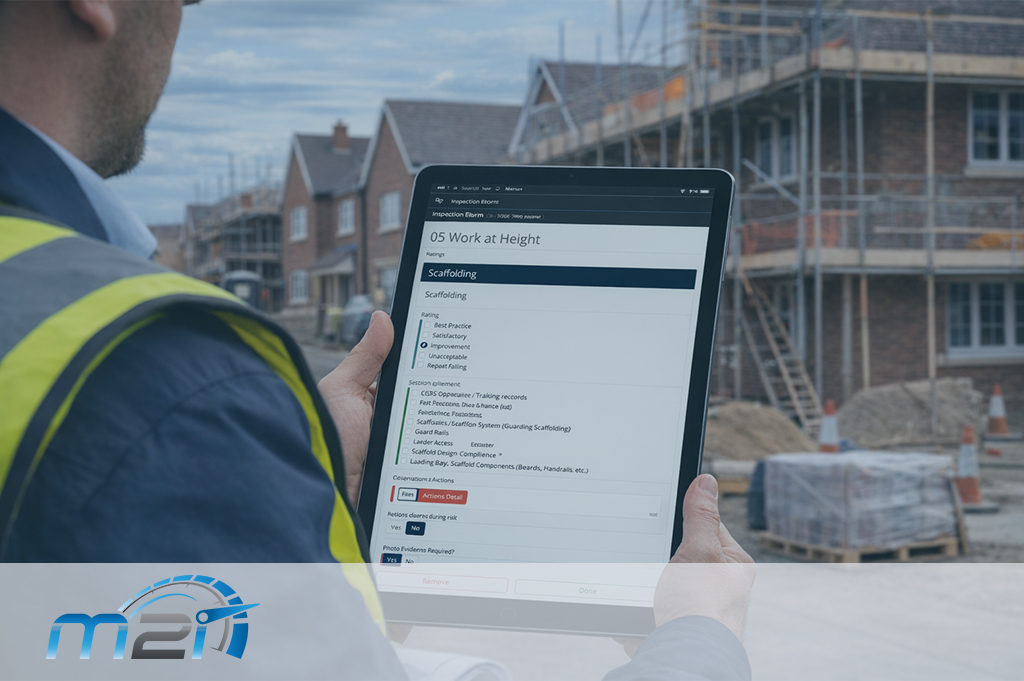
The Building Safety Act continues to reshape the responsibilities of principal contractors and dutyholders, particularly regarding higher-risk buildings. Today, these projects require much more rigorous documentation and reporting standards. The Health and Safety Executive (HSE) and the Building Safety Regulator increasingly expect accurate, accessible digital safety records as part of compliance.
Modern construction businesses are moving away from fragmented spreadsheets and cumbersome paper-based systems toward centralised SHEQ (Safety, Health, Environment, Quality) platforms. These systems provide a clear audit trail, version control, incident records, inspection histories, and contractor documentation all in one accessible place.
With platforms like m2i.SHEQ, construction firms can streamline:
- Audits
- Inspections
- Document management
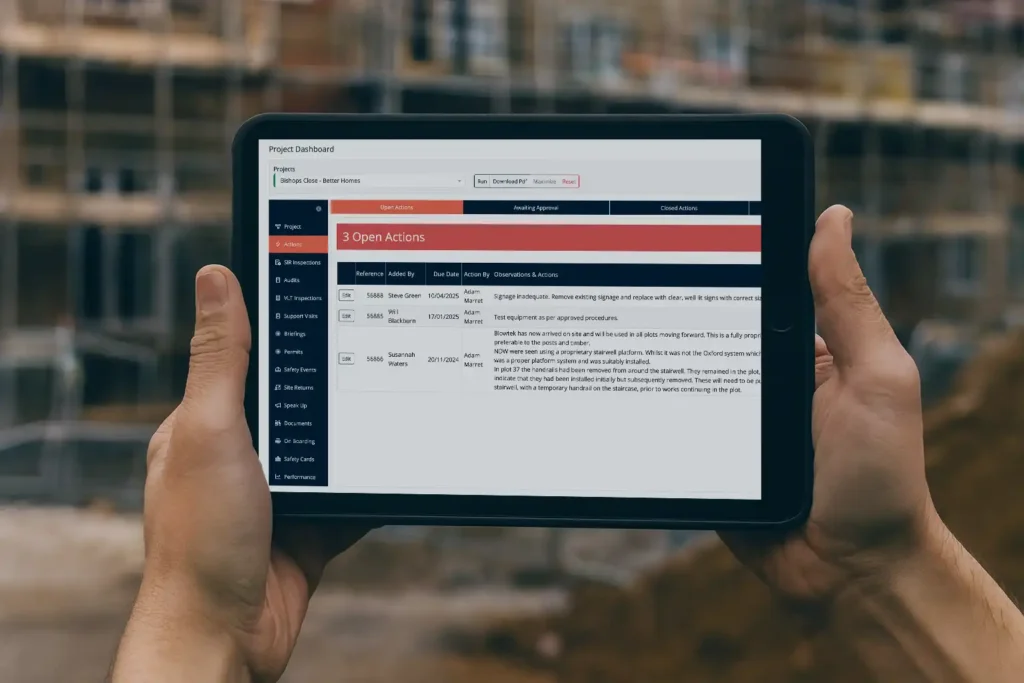
- Corrective actions
- Incident reporting
- Competency records…
…ensuring faster, more reliable compliance and enhanced safety oversight.
Why contractor competence management is becoming critical
Ensuring contractor competency is no longer optional – it’s fundamental. Construction companies must verify subcontractor qualifications, monitor training expiry dates, record toolbox talks, and demonstrably maintain competence to satisfy clients and regulatory bodies.
Government guidance increasingly emphasises the importance of proving competence and maintaining reliable, documented information. Failure to do so risks non-compliance and potential project delays or penalties.
Modern digital SHEQ platforms like m2i.SHEQ help construction companies maintain live competency records, automate reminders for expiring certifications, and provide auditable evidence during inspections or client reviews. This level of oversight fosters safer workplaces and smoother project delivery. [Read more about m2i.SHEQ for Construction]
Real-time safety reporting on construction sites
Construction sites are dynamic environments where conditions can change rapidly. Real-time safety reporting is critical for effective risk management and compliance.
Through mobile inspections, site managers can instantly log near misses, hazards and incidents as they arise. This capability reduces paperwork delays and facilitates faster corrective action tracking, driving timely responses that prevent accidents.
The HSE emphasises robust planning, monitoring, and coordination of construction safety measures. Cloud-based SHEQ software like m2i.SHEQ enables site teams to capture inspections, incidents, and observations directly from the field. By doing so, construction businesses can more quickly identify and resolve emerging risks while maintaining a complete compliance record.
Mental health and psychological safety in construction
Mental health is increasingly recognised as a critical element of construction safety management. Challenges such as fatigue, stress, burnout, and long working hours impact worker well-being and performance on site, while psychological safety determines whether workers feel comfortable reporting hazards or concerns.
Near-miss underreporting is often linked to mental health factors, reducing the organisation’s ability to proactively manage risks.
The industry is moving beyond treating mental well-being as a separate Human Resources issue, recognising its direct impact on safety outcomes.
Modern SHEQ systems can support a stronger reporting culture by making hazard, observation, and wellbeing reporting simpler, faster, and more consistent across projects. By integrating mental health considerations into SHEQ processes, organisations take a holistic approach to site safety.
Health and Safety management in construction: Core principles
Construction sites are fast-paced environments where workers use heavy equipment and materials, creating diverse hazards. Effective health and safety management is essential to identify, mitigate, and prevent risks that endanger workers and others.
Key components include:
Hazard identification
Hazards in construction can be physical, chemical, biological, ergonomic, or psychological. Identifying them involves risk assessments based on various sources such as equipment, materials, work practices, or environmental factors.
Risk assessment and management
Following hazard identification, companies assess the likelihood and impact, then apply control measures—ranging from elimination and substitution to engineering controls, administrative measures, and personal protective equipment (PPE).
Training and education
Proper training on equipment use, emergency procedures, and PPE is vital to equip workers with knowledge to protect themselves and others.
Incident reporting and investigation
Prompt reporting and investigating of accidents, near-misses, and incidents help uncover root causes and implement corrective actions to prevent recurrence.
Continuous improvement
Safety management is an ongoing process involving regular review and updating of policies, risk assessments, and training to adapt to changing circumstances and emerging risks.
Why is Health and Safety management important in construction?
Construction remains one of the most hazardous industries, with high accident and fatality rates worldwide. Effective health and safety management:
- Protects workers and bystanders from harm.
- Ensures legal and regulatory compliance.
- Reduces accidents, injuries, and related illnesses.
- Improves productivity and work quality.
- Enhances organisational reputation.
- Lowers costs associated with workers’ compensation, insurance and litigation.
Conclusion
Construction health and safety management has never been more critical or complex. The evolving regulatory landscape, heightened expectations for digital record-keeping, and growing focus on mental wellbeing demand modern solutions.
By embracing digital SHEQ platforms like m2i.SHEQ, construction organisations can:
- Centralise and simplify documentation and reporting.
- Ensure contractor competence and track training continually.
- Deliver real-time insights through mobile inspections and incident reporting.
- Foster a culture that prioritises physical and psychological safety.
These capabilities support safer work environments, regulatory compliance, and operational excellence. Contact us to find out more about how m2i.SHEQ can support your construction business.