
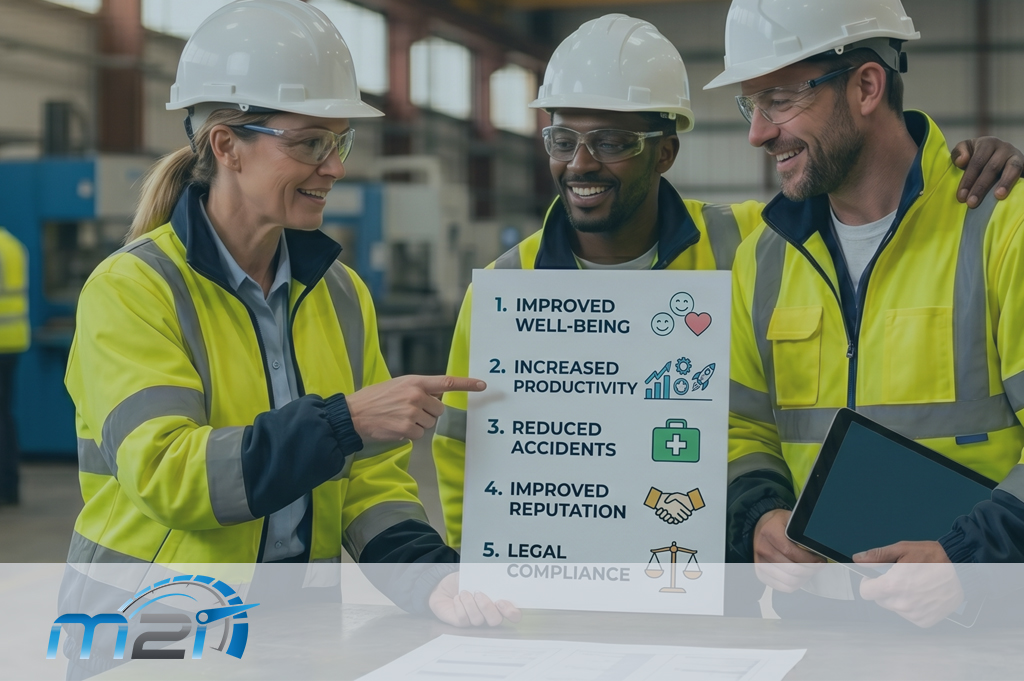
A positive health and safety culture is more than a compliance requirement. It’s the collective attitudes, beliefs, and values that shape how your people behave when it comes to safety — not because they have to, but because they want to.
When employees feel valued, supported and safe, they are more engaged, productive and loyal. When safety becomes “the way we do things around here”, incidents fall, morale rises and organisations thrive.
But culture doesn’t happen by accident. It requires visible leadership, consistent systems, open communication, and the tools to make safe behaviour easy and rewarding.
This article explores the benefits of a positive health and safety culture — and how digital tools like m2i.SHEQ can help organisations embed that culture across every site, team, and role.
What is a positive health and safety culture?
What is a health and safety culture?
One long-standing definition is “The product of individual and group values, attitudes, perceptions, competencies and patterns of behaviour that determine the commitment to, and the style and proficiency of, an organisation’s health and safety management.” (ACSNI, 1993)
In practical terms, a positive safety culture means:
- Leadership commitment: safety is visibly prioritised at every level.
- Worker involvement: employees actively participate in identifying and resolving hazards.
- Open communication: people feel safe to speak up without fear of blame.
- Learning culture: the organisation learns from incidents, near-misses, and observations.
- Consistency: safe behaviours are embedded in daily routines, not treated as exceptions
Organisations with mature safety cultures don’t just react to incidents. They anticipate risks, engage their workforce and continuously improve.
The challenge is making this happen consistently — especially across complex, multi-site operations. That’s where digital SHEQ platforms like m2i.SHEQ play a critical role.
The benefits of a positive health and safety culture
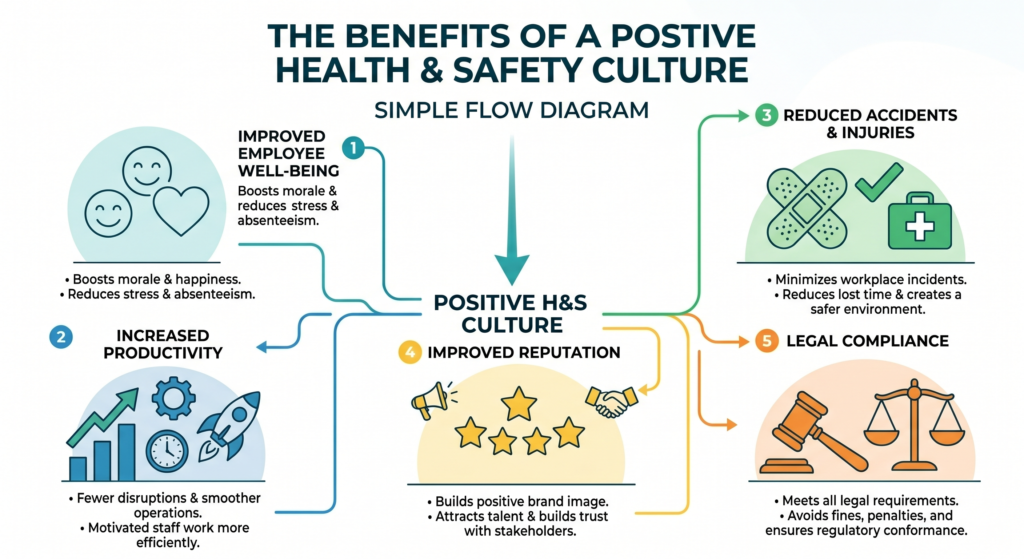
1. Improved employee well-being
A positive safety culture promotes a healthy work environment, which is essential for employee well-being. When people feel safe and secure, they are less likely to experience stress, anxiety, and other mental health issues. They are also less likely to suffer from physical health problems such as musculoskeletal injuries, fatigue and occupational illness.
But well-being isn’t just about the absence of harm. It’s about feeling heard, valued and supported.
A strong safety culture gives employees a voice. It encourages them to report hazards, raise concerns and contribute to continuous improvement — without fear of blame or dismissal.
How m2i.SHEQ supports this:
m2i.SHEQ is designed to make reporting easy and accessible. The platform includes:
- Observation cards and ‘Speak Ups‘: tools that encourage employees to report unsafe conditions, near-misses, and positive behaviours in real time.
- Mobile app with offline functionality: enabling frontline workers to log events, conduct inspections, and raise actions anywhere, even without internet access.
- Workflow automation: ensuring that every concern is tracked, assigned, and resolved, so employees see that their input leads to action.
When employees know their voice matters — and that the organisation will act on their concerns — well-being improves, and trust grows.
2. Increased productivity
When employees feel safe at work, they are more productive. A positive safety culture creates an environment where people can focus on their tasks without distraction from unresolved hazards, unclear procedures, or administrative burden.
Safety and productivity are not competing priorities. Done well, safety management removes friction, standardises processes, and frees people to do their best work.
How m2i.SHEQ supports this:
m2i.SHEQ streamlines safety management so that it enhances — rather than hinders — operational performance:
- Workflow automation: triggers actions, alerts, and notifications based on business rules, reducing manual admin and ensuring nothing falls through the cracks.
- Digitised inspections and audits: structured templates with scoring and audit trails standardise workplace checks and eliminate paper-based inefficiency.
- Configurable dashboards: provide instant visibility of safety performance, so managers spend less time chasing information and more time acting on it.
By embedding safety into daily routines — and making compliance effortless — m2i.SHEQ helps organisations achieve both safety and productivity goals.
3. Reduced accidents and injuries
This is the most direct benefit of a positive safety culture. Organisations that prioritise safety, engage their workforce, and learn from incidents consistently achieve lower accident and injury rates.
But reducing harm requires more than reactive incident management. It requires:
- Proactive hazard identification: spotting risks before they cause harm.
- Open reporting: encouraging near-miss and observation reporting, not just injury logs.
- Learning from events: investigating root causes and implementing preventative action.
- Trend analysis: identifying patterns across sites, teams, and time periods.
How m2i.SHEQ supports this:
m2i.SHEQ provides a comprehensive safety event management system that supports proactive safety management through:
- Real-time alerts: notifying relevant people immediately when events are logged.
- Trend analysis and forecasting: identifying patterns early so organisations can intervene before incidents occur.
- Action tracking: assigning and monitoring corrective actions, integrated with events, inspections, and audits.
- Audit trails: providing full visibility of what happened, when, and what was done about it
This shifts the focus from reactive compliance to proactive prevention — a hallmark of mature safety cultures.
The safety statistics functionality within the m2i.SHEQ software system plays a critical role in advancing an organisation’s safety culture.
4. Improved reputation
Organisations that prioritise health and safety are seen as responsible, professional, and trustworthy. This reputation matters — to clients, investors, regulators, and potential employees.
In sectors like construction, utilities and housing, a strong safety record is often a prerequisite for winning work. Clients want to see evidence that contractors and suppliers take safety seriously — not just in policy documents, but in practice.
A positive safety culture also supports employee retention and recruitment. People want to work for organisations that care about their well-being.
How m2i.SHEQ supports this:
m2i.SHEQ provides the evidence and visibility that organisations need to demonstrate their commitment to safety:
- Configurable reports and dashboards: accessible to leadership, clients, and auditors, showing safety performance at a glance.
- Full audit trails: documenting inspections, incidents, actions, and outcomes.
- Consistent processes across sites: ensuring that safety standards are maintained wherever work takes place.
By making safety performance transparent and measurable, m2i.SHEQ helps organisations build and protect their reputation.
5. Legal compliance
Health and safety legislation requires organisations to provide a safe working environment for their employees. Failure to comply can result in enforcement action, fines, prosecution, and — in serious cases — imprisonment.
But compliance should be the baseline, not the goal. A positive safety culture goes beyond legal minimums to embed safety as a core organisational value.
That said, digital tools play a critical role in ensuring compliance is achieved consistently and efficiently.
How m2i.SHEQ supports this:
m2i.SHEQ helps organisations meet their legal obligations through:
- Structured inspections and audits: with templates, scoring, and mandatory fields to ensure nothing is missed.
- Real-time monitoring: providing instant visibility of compliance status across sites.
- Automated workflows: ensuring that actions are assigned, tracked, and completed within required timeframes.
- Comprehensive audit trails: providing documentary evidence of compliance for regulators and auditors.
The platform supports the HSE’s “Plan, Do, Check, Act” framework by embedding continuous monitoring and improvement into daily operations.
How m2i.SHEQ enables a positive safety culture
The benefits above are not achieved through software alone. Culture is ultimately about people — their attitudes, behaviours, and commitment.
But the right tools can enable and reinforce the behaviours that define a positive safety culture:
| Cultural driver | How m2i.SHEQ supports it |
|---|---|
| Worker involvement | Speak Ups, observation cards, mobile access |
| Open communication | Real-time alerts, shared dashboards, transparent reporting |
| Integrated compliance frameworks | Support for ISO 9001, ISO 14001, ISO 45001 and other standards |
| Learning culture | Incident investigation, trend analysis, action tracking |
| Consistency | Standardised inspections, automated workflows, audit trails |
| System integration | Connected operations, single source of truth |
| Leadership visibility | Dashboards, KPIs, strategic reporting |
By making safe behaviour easy, visible, and rewarding — and by ensuring that concerns are heard and acted upon — m2i.SHEQ helps organisations move from compliance-driven safety management to genuine cultural change.
Conclusion
A positive health and safety culture delivers measurable benefits: improved well-being, increased productivity, fewer accidents, stronger reputation, and robust compliance.
But culture requires commitment — and the right systems to sustain it.
m2i.SHEQ provides the digital infrastructure to support a proactive, engaged, and learning-oriented safety culture. From frontline observations to boardroom dashboards, the platform connects your people, processes, and data in one integrated system.
If you’re ready to move beyond compliance and build a safety culture that drives performance, talk to us about m2i.SHEQ.