
A health and safety management system provides the structure organisations need to protect their people, meet legal obligations, and continuously improve safety performance. Here’s what it involves – and how the right tools make implementation practical.
Defining a Health and Safety Management System
A health and safety management system (HSMS) is a structured set of policies, procedures, and plans designed to systematically manage workplace health and safety. Its purpose is straightforward: to minimise the risk of injury and illness for everyone connected to your organisation – employees, contractors, suppliers and visitors.
In practice, a management system can take many forms. It might be a documented framework, a set of guidelines, or a formal system aligned to standards like ISO 45001. What matters is that it provides a consistent, organised approach to:
- Identifying hazards and assessing risks.
- Establishing procedures to control those risks.
- Recording and investigating incidents.
- Monitoring compliance through inspections and audits.
- Tracking actions and driving continuous improvement.
For organisations employing five or more people, having a written health and safety policy is a legal requirement in the UK. But a policy alone isn’t a management system. The real challenge lies in turning policy commitments into consistent, day-to-day practice across the business.
The Plan-Do-Check-Act cycle
Effective health and safety management isn’t a one-off exercise – it’s a continuous process of improvement. The widely recognised model follows four stages:
Plan: Identify hazards, assess risks, and determine the controls needed. Set objectives and define how performance will be measured.
Do: Implement the planned controls and procedures. Ensure people are trained, competent, and understand their responsibilities.
Check: Monitor performance through inspections, audits, incident reporting, and data analysis. Verify that controls are working as intended.
Act: Review findings, learn from incidents, and make improvements. Update procedures and controls based on what the data tells you.
Each stage feeds into the next, creating a loop that drives ongoing refinement of your safety management approach.
The 5 aspects of Health and Safety Management
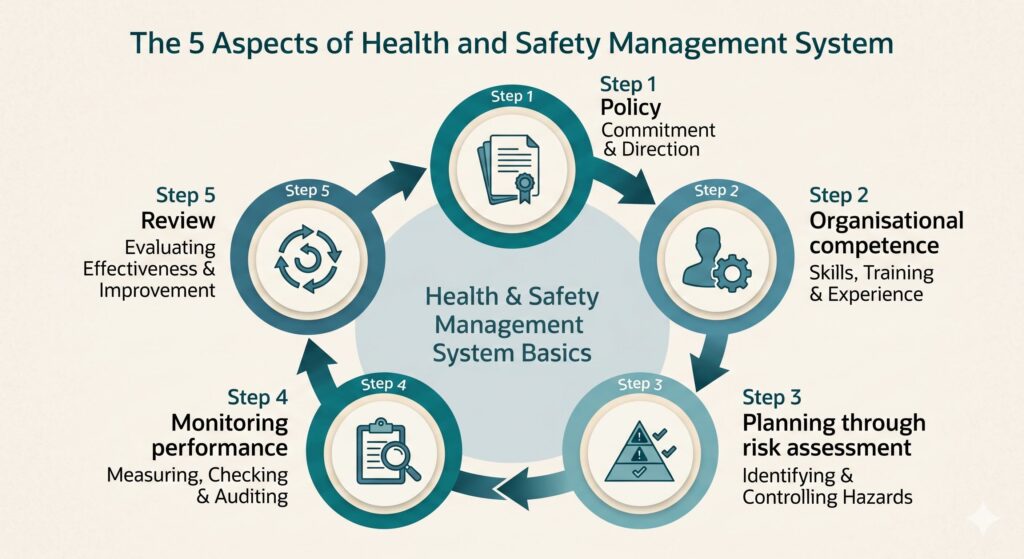
The Health and Safety Executive’s guidance (HSG65) identifies five core aspects of an effective management system:
Policy: Establishing your commitment and setting the direction for health and safety management.
Organising (Competence): Ensuring people have the skills, knowledge, and resources to fulfil their responsibilities.
Planning through Risk Assessment: Identifying hazards, assessing risks, and determining appropriate controls.
Monitoring performance: Checking that standards are being met through inspections, audits, and data analysis.
Review: Evaluating overall performance and making improvements based on what you learn.
These aspects form a continuous cycle — each one informing and reinforcing the others.
Key components of an effective Management System
While every organisation’s system will reflect its specific risks and operations, effective health and safety management systems share common elements. The chart above sums this up neatly, but here’s more detail.
Leadership and commitment
Safety performance starts at the top. Senior leaders must visibly commit to health and safety, allocate appropriate resources, and hold themselves and others accountable for results.
Policy
A clear, documented policy sets out the organisation’s commitment to health and safety, defines responsibilities, and establishes the framework within which decisions are made.
Organisational competence
People at every level need the knowledge and skills to fulfil their safety responsibilities. This means identifying training needs, delivering appropriate programmes, and maintaining records of competence.
Hazard identification and risk management
A systematic process for identifying hazards and assessing risks is fundamental. This includes conducting risk assessments, implementing controls based on the hierarchy of control, and reviewing assessments when circumstances change.
Inspections and audits
Regular inspections of premises, equipment, workplaces, and work practices verify that standards are being maintained. Audits provide a more comprehensive review of whether the management system as a whole is operating effectively.
Incident investigation
When things go wrong — or nearly go wrong — a robust investigation process helps identify root causes and prevent recurrence. This applies to accidents, near misses, and hazardous observations.
Monitoring and measurement
You can’t manage what you don’t measure. An effective system tracks both leading indicators (inspections completed, training delivered, hazards reported) and lagging indicators (accident rates, lost time injuries, RIDDOR reports).
Review and continuous improvement
Regular review of safety performance — at management and board level — ensures that lessons are learned, trends are identified, and the system evolves to address new and emerging risks.
The challenge of implementation
Most organisations understand what a health and safety management system should include. The difficulty is making it work in practice — especially as the business grows or operates across multiple sites.
Common obstacles include:
- Paper-based processes that are slow, inconsistent, and difficult to consolidate.
- Fragmented data held in spreadsheets, emails, and filing cabinets.
- Manual reporting that consumes administrative time and delays visibility.
- Inconsistent standards across sites, projects, or business units.
- Actions that aren’t tracked to completion.
- Leadership teams lacking real-time insight into safety performance.
These challenges don’t reflect a lack of commitment — they reflect the practical limits of managing complex, distributed operations without the right tools.
How m2i.SHEQ supports your management system
m2i.SHEQ is designed to make health and safety management systems work in practice — not just on paper.
The platform provides a single, integrated system for capturing safety data, managing actions, and turning information into insight. It supports the full Plan-Do-Check-Act cycle and gives leadership teams the visibility they need to drive performance.
Policy and commitment in action
m2i.SHEQ helps translate policy commitments into operational reality by providing consistent, structured processes that apply across the organisation.
Hazard identification and risk management
Capture hazards, near misses, and safety observations directly from the workplace. Ensure every identified risk is recorded, assessed, and linked to appropriate control measures.
Inspections and audits
Replace paper-based inspections with digital forms that can be completed on any device. Standardise inspection criteria, ensure findings are captured consistently, and flow results automatically into action tracking.
Incident investigation
Record all safety events – accidents, near misses, dangerous occurrences – in a single system. Manage investigations, document root causes, and track corrective actions to completion.
Actions management
Every issue identified – whether through inspection, incident, audit, or observation – generates a tracked action. Assign ownership, set deadlines, and monitor progress until closure.
Monitoring and measurement
Automatically calculate key safety KPIs, including AFR, AIR, and AAIR, on a monthly and rolling 12-month basis. Eliminate manual spreadsheet work and ensure accurate, consistent reporting.
Review and continuous improvement
Dashboards provide real-time visibility of safety performance across the organisation. Generate reports for management reviews, board meetings, or client submissions — based on current, reliable data.
Building a culture of safety
A truly effective health and safety management system does more than ensure compliance — it establishes and maintains a culture of safety that permeates the entire organisation.
That culture depends on:
- Visible leadership commitment.
- Clear expectations and accountability.
- Consistent processes that people trust and follow.
- Timely feedback on performance.
- Recognition that safety is everyone’s responsibility.
m2i.SHEQ supports this culture by making safety management accessible, consistent, and data-driven – from the boardroom to the front line.
Is your management system working?
Consider these questions:
- Can you demonstrate how your safety policy translates into operational practice?
- Do you have real-time visibility of safety performance across all locations?
- Are inspections and audits completed consistently, with findings tracked to closure?
- How long does it take to compile your safety statistics each month?
- Are you measuring leading indicators – or just counting incidents after they happen?
If your current systems make these questions difficult to answer, it may be time to consider a more integrated approach.
Learn more
m2i.SHEQ helps organisations build management systems that work – capturing data, tracking actions, calculating KPIs automatically, and providing the insight needed to drive continuous improvement.
To explore how the platform can support your health and safety management system, get in touch for a conversation.