
By eliminating dependency on the software developer, m2i.SHEQ allows administrators to update forms, workflows and reports instantly across web, mobile and APIs. It’s designed to save time, cut consultancy costs and keep your safety compliance perfectly aligned with operational change.
It’s a challenge across industries. In this blog we explain why we do things differently, and the benefits for business like yours.
What’s ‘developer dependency’ and why is it a problem?
In fast-paced, highly regulated sectors like construction, housebuilding and utilities, change is the only constant. New regulatory frameworks emerge, project requirements shift, and internal Safety, Health, Environment and Quality (SHEQ) standards continuously evolve.
Yet, many enterprise software platforms treat change as a problem rather than a feature.
When your business needs to track a new safety attribute, modify an audit workflow or add a field for subcontractor ratings, traditional SHEQ tools often present a major hurdle: developer dependency.
Making a simple structural change can require vendor change requests, costly consultancy hours and weeks (or months) of waiting for developer cycles.
At measure2improve, we built m2i.SHEQ around a fundamentally different philosophy: your software should adapt to your operational reality instantly, without requiring line-by-line coding or expensive technical support.
The hidden cost of rigid data schemas
When a software platform lacks administrative flexibility, the hidden costs accumulate quickly across three main areas:
Operational delays & regulatory exposure
When new compliance rules take effect, HSE managers cannot afford to wait months for vendor updates. When software lags behind operational reality, teams fall back on paper forms, spreadsheets and temporary patches, creating compliance risks and fragmented data silos.
High Total Cost of Ownership (TCO)
Relying on software vendors for basic schema updates turns routine modifications into ongoing consultancy bills. Over a system’s lifecycle, these professional services fees can dwarf the initial software investment.
The “Ripple Effect” friction
In legacy architectures, adding a new field in one area doesn’t automatically carry over elsewhere. Administrators often have to configure that field separately for mobile apps, reporting engines, permission hierarchies and API endpoints.
The engine behind agility: the Integrated Data Library
At the core of the m2i.SHEQ cloud platform is an architecture designed around an Integrated Data Library, one of our extended modules for additional functionality. This central data engine gives platform administrators the power to create, modify or extend tables, attributes and data relationships directly. Zero code changes and zero vendor involvement.
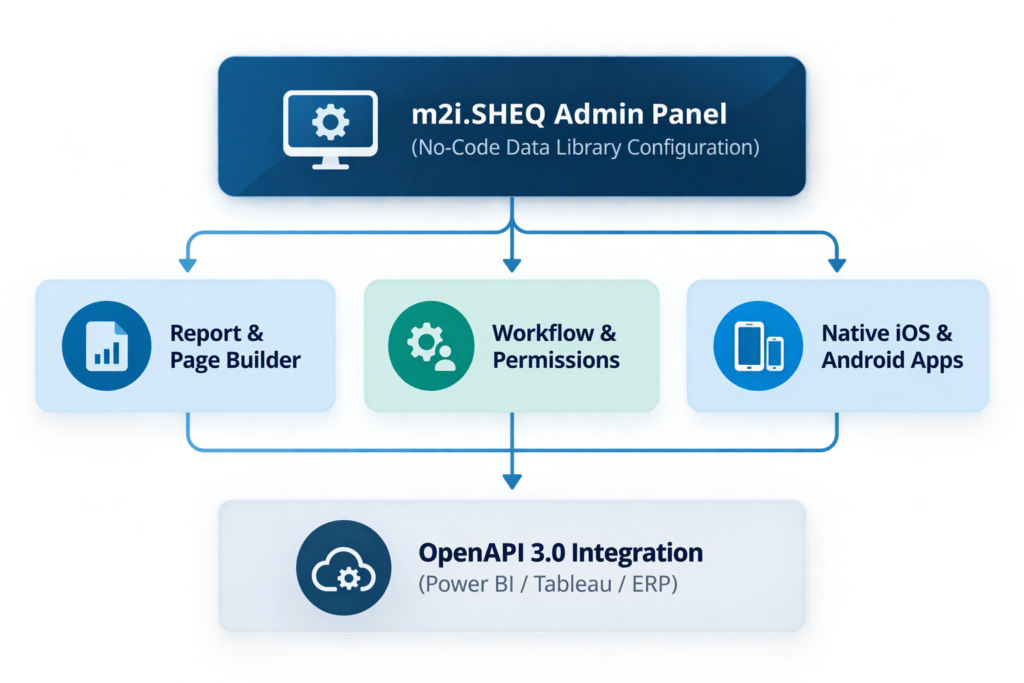
The true power of this no-code framework is its automatic multi-surface propagation. Let’s explain: when an administrator adds or updates a data structure in m2i.SHEQ, those changes instantly and seamlessly reflect across the entire platform ecosystem:
- Report Builder: Custom attributes immediately become filterable, queryable data points in your reporting views.
- Workflow Builder: New data fields automatically feed into rule engines, automated escalations and sign-off chains.
- Permissions Builder: Dynamic role- and project-based access rules apply to newly created attributes instantly.
- Web Page Builder: Admin-configured fields dynamically populate onto desktop user interfaces without custom layout development.
- Offline Mobile App: Changes auto-sync to native iOS and Android apps, ensuring field teams on remote construction sites or utility sub-stations have immediate access to updated forms without needing an app store release.
- API & Business Intelligence: Updated data schemas instantly publish to m2i.SHEQ’s OpenAPI 3.0-compliant endpoints, allowing live feeds directly into BI tools like Power BI or Tableau.
Real-world impact: connecting data to operations
To see how this works in practice, consider managing critical compliance documentation, such as Risk Assessments and Method Statements (RAMS), safety policies or operational procedures.
Through extended capabilities like the Document Library Module, foundational paperwork and compliance records link directly to core operational workflows. These include Digital Inspections & Audits, Quality Assurance and Safety Event Management.
When a project scope expands or site conditions change, your team can adjust document categorisation, update risk attributes or refine review workflows on the fly. On-site staff and subcontractors always work from the single, correct source of truth, backed by complete version control and automated audit trails.

Built for enterprise performance and security
No-code flexibility does not mean compromising on enterprise security or compliance standards. The m2i.SHEQ platform operates within a robust, cloud-hosted environment built to meet rigorous international benchmarks:
- Standards compliance: Designed to support ISO 9001, ISO 20000-1, ISO 27001, Cyber Essentials and GDPR requirements.
- Mobile-first reliability: Native offline sync ensures data integrity even when working in zero-signal environments.
- Interoperability: Open APIs prevent vendor lock-in and keep your SHEQ ecosystem connected to broader enterprise systems.
Adaptability as a competitive advantage
In high-consequence industries, software should never be a bottleneck to operational safety or compliance. By eliminating developer dependency for routine structural updates, m2i.SHEQ puts control back into the hands of safety and operations leaders, saving time, reducing software lifecycle costs and keeping teams agile.
To find out more or request a demo, please contact us.