How 25 Years of Innovation has Transformed Safety, Health, Environment and Quality Management
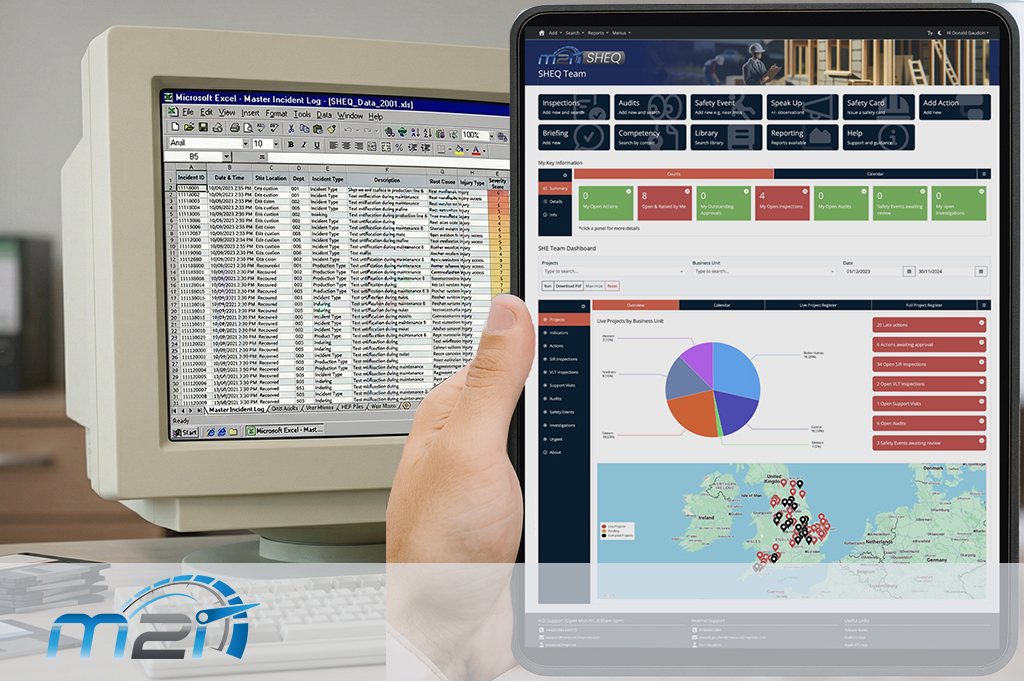
If you’re still relying on spreadsheets and paper-based systems to manage your organisation’s safety, health, environment and quality (SHEQ) responsibilities, you’re not alone. Many businesses find themselves overwhelmed by paperwork, struggling to keep up with compliance requirements, and unable to extract meaningful insights from their data.
But SHEQ software has come a long way. Over the past 25 years, these tools have evolved from basic digital record-keeping into intelligent, integrated platforms that don’t just document incidents – they help prevent them.
Understanding this evolution can help you assess whether your current systems are holding you back, and what modern SHEQ software can truly deliver.
The early days: paper to basic digital systems (late 1990s – early 2000s)
The journey of SHEQ software began in the late 1990s when organisations first started replacing paper-based systems with simple digital tools. It’s where m2i first emerged, seeing the potential that SHEQ software could deliver to businesses.
What early SHEQ software looked like
During this period, most organisations managed safety, environmental and quality functions separately. Each department maintained its own records, creating data silos that made cross-functional analysis almost impossible.
• Spreadsheet-based compliance tracking.
• Basic document repositories.
• Manual incident logging.
• Static, time-consuming reporting.
The limitations were significant:
• Slow analysis of incidents or emerging trends.
• High administrative workload.
• Reactive rather than proactive management.
• Duplication of effort across departments.
Early SHEQ software was essentially a digital filing cabinet. It helped organisations record what had happened, but offered little support for preventing future incidents.
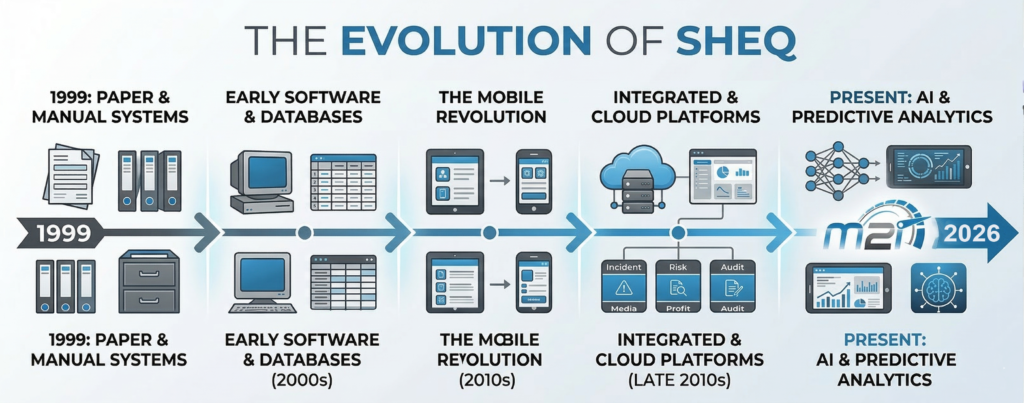
The integration era: unified management systems (2005–2015)
As management standards like ISO 9001, ISO 14001 and OHSAS 18001 (later ISO 45001) became more widespread, organisations recognised the inefficiency of managing compliance in silos.
This drove the development of Integrated Management Systems (IMS) – and SHEQ software evolved to support them.
Key developments during this period:
• Centralised databases for all SHEQ records.
• Digital audit trails replacing paper documentation.
• Document control systems with version management.
• Compliance dashboards providing overview visibility.
The impact was substantial:
• Reduced duplication of documentation.
• Easier preparation for audits and inspections.
• Improved collaboration between safety, quality, and environmental teams.
• Single source of truth for compliance data.
This shift from siloed management to integrated systems was arguably the most important transition in SHEQ software history. For the first time, organisations could see their safety, health, environmental and quality performance in one place – and m2i.SHEQ led the way.
Cloud and mobile transformation (2015–2020)
The next wave of innovation was driven by two technologies that changed how we work: cloud computing and mobile devices.
SHEQ software capabilities expanded dramatically:
• Web-based platforms accessible from anywhere, on any device.
• Mobile incident reporting with photo uploads.
• Real-time inspection and audit tools.
• Automated alerts and notifications.
• Offline functionality for remote locations.
This transformation fundamentally changed who could engage with SHEQ systems. Instead of data being entered by administrators back in the office, frontline workers could report incidents, complete inspections, and log observations directly from site.
The results were transformative:
• Faster incident reporting – in minutes instead of days.
• Significant reduction in paperwork.
• Greater workforce engagement in safety culture.
• More accurate, timely data for decision-making.
Platforms like m2i.SHEQ popularised digital inspections and mobile audits during this period, demonstrating the appetite for mobile-first SHEQ tools. Paper checklists increasingly became a thing of the past.
Data-driven and predictive systems (2020–present)
The most recent generation of SHEQ software focuses on something more ambitious than record-keeping or even real-time reporting. Today’s platforms aim to predict and prevent incidents before they occur.
Modern SHEQ software capabilities include:
• Predictive risk analytics: identifying patterns that indicate emerging risks.
• Real-time dashboards and KPIs: instant visibility of performance metrics.
• AI-driven insights: automated analysis of large datasets.
• API integrations: connecting with HR, ERP, CRM, and business intelligence tools.
• IoT sensor data: environmental monitoring and automated alerts.
• Automated compliance tracking: reducing manual oversight.
This represents a fundamental shift in how organisations think about SHEQ. Rather than being a compliance function that documents what went wrong, SHEQ software now serves as a strategic management tool that drives operational performance.
Modern platforms like m2i.SHEQ transform data into action:
• Trend analysis identifies problem areas before incidents occur.
• Automated workflows ensure issues are addressed promptly.
• Analytics support evidence-based decision-making.
• Integration with enterprise systems provides complete operational visibility.
What modern SHEQ software delivers
When evaluating SHEQ software today, organisations should expect capabilities that reflect this 25-year evolution:
| Capability | Why it matters |
|---|---|
| Cloud-first architecture | Access from anywhere, automatic updates, reduced IT overhead |
| Mobile field reporting | Frontline engagement, real-time data capture |
| Integrated compliance frameworks | Support for ISO 9001, ISO 14001, ISO 45001 and other standards |
| Automated audits and workflows | Reduced administrative burden, consistent processes |
| Advanced analytics and dashboards | Data-driven decision-making, trend identification |
| Enterprise system integration | Connected operations, single source of truth |
| Workflow automation | Nothing falls through the cracks |
The best SHEQ software platforms act as operational intelligence systems, not just compliance databases.
The strategic shift: from recording to preventing
Looking at the evolution of SHEQ software, a clear pattern emerges:
| Period | Primary focus | Technology |
|---|---|---|
| 1995–2005 | Record keeping | Spreadsheets, basic databases |
| 2005–2015 | Integrated compliance | IMS platforms |
| 2015–2020 | Digital transformation | Cloud + mobile |
| 2020–present | Predictive risk management | AI, analytics, IoT |
The emphasis has shifted decisively from documenting incidents to preventing them.
This reflects a broader change in organisational thinking. SHEQ is no longer viewed as a back-office compliance function. It’s now recognised as a core component of operational performance, sustainability and enterprise risk management.
Is your SHEQ software keeping pace?
If your organisation is still managing SHEQ through spreadsheets, paper forms or disconnected systems, you’re likely experiencing the limitations that drove each wave of innovation:
• Administrative overload: too much time spent on data entry and paperwork
• Poor visibility: difficulty seeing the complete picture across projects or sites
• Reactive management: finding out about problems after they’ve occurred
• Compliance anxiety: uncertainty about audit readiness
• Missed insights: data exists but isn’t being used to drive improvement
Modern SHEQ software addresses all of these challenges through automation, integration and intelligence.
Making the shift to modern SHEQ Software
Transitioning from legacy systems to a modern SHEQ platform doesn’t have to be overwhelming. The key is finding a solution that matches your organisation’s complexity and can grow with your needs.
What to look for:
• Ease of use: if frontline teams won’t use it, data quality suffers
• Flexibility: configurable to your processes, not forcing you into rigid workflows
• Mobile capability: essential for field-based operations
• Support and partnership: ongoing relationship, not just a software licence
• Proven track record: evidence of successful implementations in your sector
At measure2improve, we’ve spent over 25 years helping organisations navigate this evolution. Our m2i.SHEQ platform reflects the industry’s progression toward integrated, data-driven compliance management – combining automated reporting, workflow automation, real-time dashboards and mobile accessibility in one user-friendly system.
Whether you’re in construction, housebuilding, water infrastructure or other high-risk sectors, modern SHEQ software can transform how you manage safety, health, environment and quality.
Conclusion: SHEQ software as a strategic asset
SHEQ is no longer just about compliance. It’s a core component of operational performance, sustainability and risk management.
If your current systems aren’t delivering these capabilities, it may be time to explore what modern SHEQ software can do for your organisation.
Ready to see how modern SHEQ software can transform your operations?
Book a call back to discuss your requirements with our team, or request a demo to see m2i.SHEQ in action.