The m2i.SHEQ platform directly supports duty-holders in meeting their CDM 2015 obligations. But how?
You’ll know that the Construction (Design and Management) Regulations 2015 (CDM 2015) are the cornerstone of health and safety in the UK construction industry. They establish clear duties for clients, principal designers and principal contractors to minimise risks, prevent accidents and safeguard workers throughout the entire lifecycle of a project.
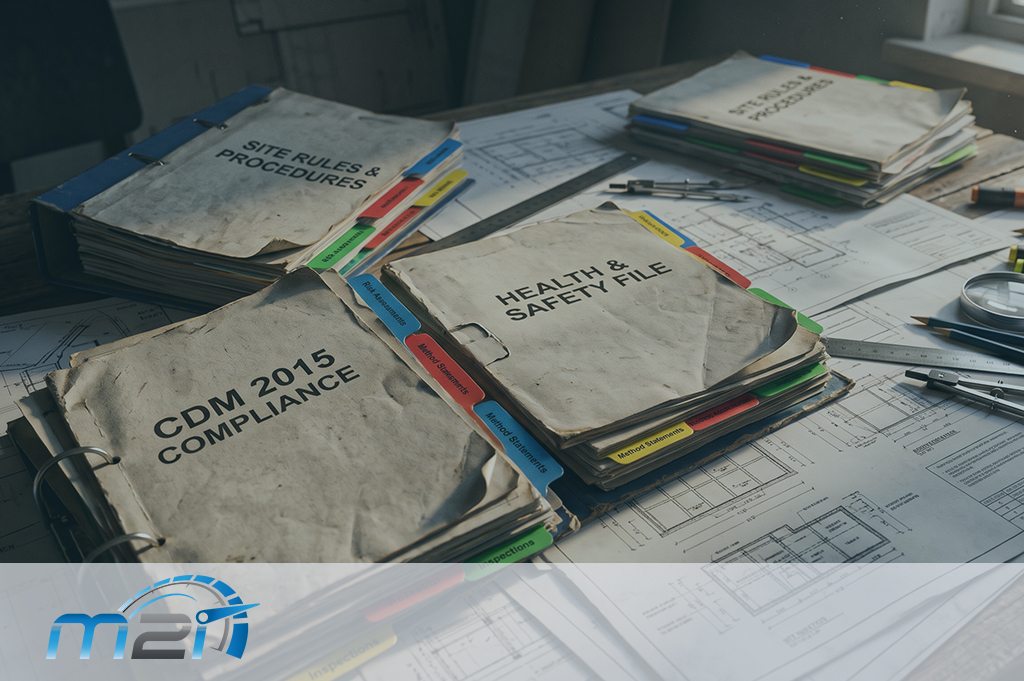
You’re reading this because you know the value that software can bring to this; the reality on many sites is that CDM compliance is still managed through a fragmented web of spreadsheets, ring-binders and scattered email threads. When documentation is siloed, risks get missed and the administrative burden on principal contractors becomes overwhelming.
This is where digital solutions like m2i.SHEQ change the game. Aligning software capabilities directly with regulatory frameworks like CDM 2015 and RIDDOR is essential for modern health and safety management.
1. Managing pre-construction information and RAMS
Under CDM 2015, principal contractors must ensure that risks are identified and mitigated before work begins. Relying on paper-based Risk Assessments and Method Statements (RAMS) often leads to outdated documents being used on-site.
The m2i.SHEQ solution: The platform’s Document Library centralises all RAMS into a single, secure repository with version control and approval workflows. Combined with the Onboarding module, subcontractors can digitally acknowledge RAMS before arriving on site.
Impact: Site Managers and H&S teams have instant visibility into which subcontractors have submitted their RAMS, whether documents have been approved, and who has acknowledged them—before anyone steps onto the site. The pre-construction phase is managed proactively, not reactively.
2. Streamlining subcontractor onboarding and competency
A core requirement of CDM 2015 is ensuring that all personnel on site have the right skills, knowledge, training and experience.
The m2i.SHEQ solution: The Onboarding and Competency modules automate subcontractor qualification checks. Operatives can self-register, complete inductions remotely and upload credentials via their smartphones, all before arriving on site.
Impact: The system tracks individual worker credentials, including CSCS card expirations and specific competency tickets, sending automated alerts before they lapse. Principal contractors can be confident that only verified, competent operatives carry out high-risk work.
3. Monitoring the construction phase with offline mobile audits
The principal contractor is responsible for planning, managing and monitoring the construction phase to ensure work is carried out without unacceptable risks to health and safety.
The m2i.SHEQ solution: The m2i.SHEQ mobile app provides full offline functionality for inspections and audits.
Impact: Site teams can conduct structured digital inspections, log observations and capture photo evidence directly from their mobile devices, even in remote locations or basements without signal. Once connectivity is restored, all data automatically synchronises with the central system. Monitoring doesn’t stop just because Wi-Fi does.
4. Incident reporting and corrective actions
When incidents or near-misses occur, rapid reporting and corrective action are vital for maintaining site safety and fulfilling statutory duties under RIDDOR.
The m2i.SHEQ solution: The Safety Event Management and Actions modules provide a closed-loop system for hazard reporting, investigation and resolution.
Impact: If a site audit fails or a near-miss is logged, workflow automation instantly triggers corrective actions and alerts the relevant duty-holders. Every step is logged with timestamps, creating a comprehensive digital audit trail that demonstrates to regulators how risks were identified and promptly addressed.
5. Building the Health and Safety file
On project completion, a comprehensive Health and Safety file must be handed over to the client to ensure future maintenance or modifications can be done safely.
The m2i.SHEQ solution: All site data, such as RAMS, audits, inspections, permits and equipment checks, is stored within a secure, ISO-accredited cloud environment throughout the project lifecycle.
Impact: Collating the final handover documentation is seamless. The days of hunting down missing paper forms at the end of a project are over. Records are already organised, easily exportable, and fully traceable.
Speed to value: compliance without the wait
One of the biggest barriers to adopting new safety software is the fear of long, disruptive implementation periods. Unlike complex enterprise systems that require months of custom engineering, m2i.SHEQ is designed for the reality of the construction sector. It can be fully configured and operational in less than four weeks, subject to your needs.
By bridging the gap between site reality and boardroom reporting, m2i.SHEQ ensures that CDM 2015 isn’t just a regulatory hurdle, but a seamlessly integrated part of your daily operations.
Ready to see how m2i.SHEQ can support your CDM compliance?
Frequently Asked Questions
What is CDM 2015 and who does it apply to?
The Construction (Design and Management) Regulations 2015 (CDM 2015) are the main regulations for managing health and safety on construction projects in the UK. They apply to all construction work and place specific duties on clients, principal designers, principal contractors, designers, and contractors.
What are the main duties of a Principal Contractor under CDM 2015?
Principal Contractors must plan, manage, and monitor the construction phase to ensure work is carried out safely. This includes ensuring adequate welfare facilities, site inductions, coordination of subcontractors, and the management of risk assessments and method statements (RAMS).
How can software help with CDM 2015 compliance?
Digital SHEQ platforms like m2i.SHEQ centralise documentation, automate competency tracking, streamline incident reporting, and provide real-time visibility across sites. This reduces administrative burden, improves audit readiness, and ensures nothing falls through the cracks.
Does m2i.SHEQ track CSCS card expiry dates?
Yes. The Competency module tracks individual qualifications, including CSCS cards, and sends automated alerts before they expire—ensuring only competent operatives are on site.
Can m2i.SHEQ be used offline on construction sites?
Yes. The m2i.SHEQ mobile app works fully offline. Inspections, audits, and safety events can be captured without signal, then automatically sync when connectivity is restored.
How does m2i.SHEQ support the Health and Safety File handover?
All project data—RAMS, inspections, audits, permits, and equipment checks—is stored in a secure, ISO-accredited cloud environment. At project completion, records are already organised and exportable, making handover documentation straightforward.
How long does it take to implement m2i.SHEQ?
m2i.SHEQ can be fully configured and operational in less than four weeks, making it significantly faster to deploy than traditional enterprise safety systems.
Is m2i.SHEQ compliant with UK data protection regulations?
Yes. The platform is fully compliant with GDPR, ISO 9001, ISO 20000-1, and Cyber Essentials. Data centres hold ISO 27001 certification.