
Effective safety management isn’t just about compliance — it’s about building a culture where risks are identified, incidents are prevented and performance is continuously improved.
The reality of construction safety
Construction remains one of the most hazardous industries in which to work. The combination of working at height, heavy plant, temporary structures, multiple trades and constantly changing site conditions creates a risk profile unlike almost any other sector.
For construction leaders, safety isn’t an abstract concern – it’s a daily operational priority. The consequences of getting it wrong are severe: harm to people, project delays, reputational damage, regulatory enforcement, and significant financial liability.
But the consequences of getting it right are equally significant. Organisations with strong safety cultures attract better people, win more work, and deliver projects more efficiently. Safety performance is increasingly a differentiator in tender evaluations and client relationships.
The challenge for most construction businesses isn’t awareness of the importance of safety – it’s translating that awareness into consistent, measurable performance across multiple sites, subcontractors and projects.
Policy is the foundation – but it’s not enough
Every construction organisation will have a clear health and safety policy. This sets out the company’s commitment to protecting its workforce and defines how risks will be managed, who is responsible, and what standards apply.
A robust policy should address:
- Leadership accountability: clear ownership of safety performance at board and senior management level.
- Roles and responsibilities: defined expectations for everyone from project directors to site operatives.
- Risk management processes: systematic approaches to hazard identification, risk assessment, and control.
- Incident management: procedures for reporting, investigating, and learning from safety events.
- Training and competence: ensuring everyone has the knowledge and skills to work safely.
- Inspection and audit: regular checks to verify that standards are being met.
- Continuous improvement: using data and feedback to drive ongoing performance gains.
However, a policy document alone doesn’t make a site safer. The real challenge is implementation: ensuring that the commitments in the policy translate into consistent action on every project, every day.
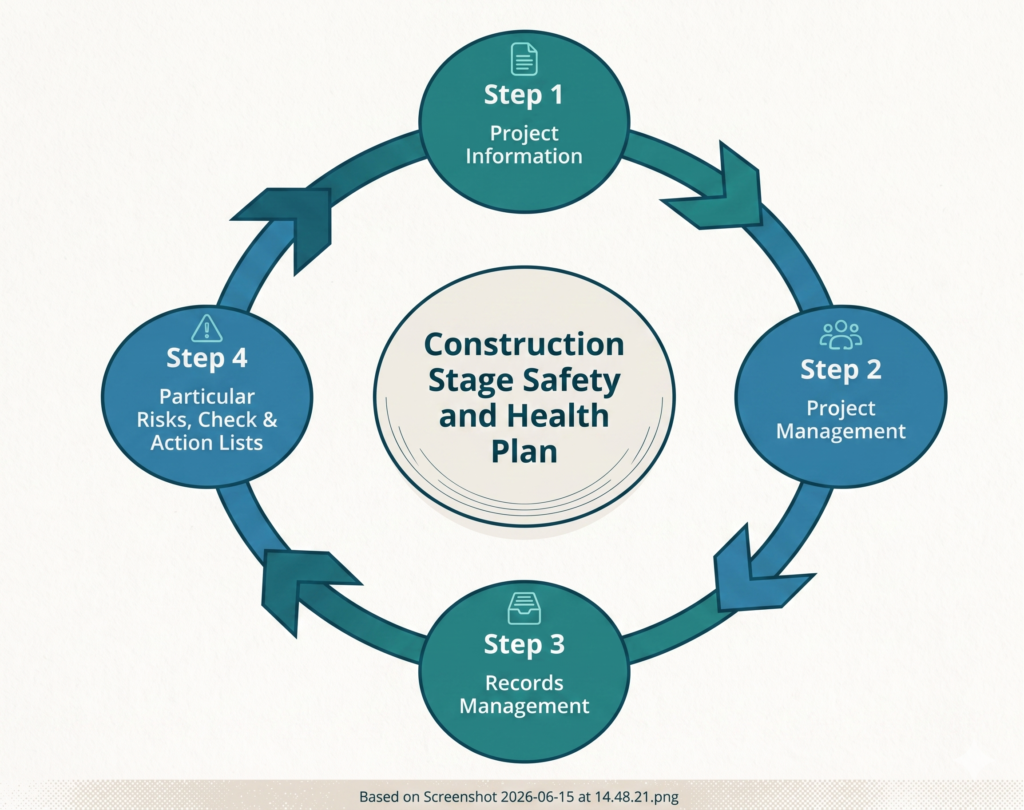
You should integrate the policy with every construction health and safety plan, factoring in project information, project management, records management and the risks, checks and actions. And every site will be different.
The gap between policy and practice
Many construction organisations find that their safety management processes work well at a small scale but become harder to maintain as the business grows.
Common challenges include:
- Inconsistent reporting: different sites using different formats, making it difficult to aggregate data or compare performance.
- Delayed information: relying on paper forms or spreadsheets means head office may not see issues until days or weeks after they occur.
- Manual KPI calculation: compiling safety statistics requires significant administrative effort and is prone to error.
- Limited visibility: leadership teams struggle to get a clear, current picture of safety performance across the organisation.
- Reactive management: without timely data, safety teams spend more time responding to incidents than preventing them.
These gaps don’t indicate a lack of commitment – they reflect the practical difficulty of managing complex, distributed operations with fragmented systems.
Moving from reactive to proactive safety management
The most effective construction organisations have moved beyond reactive safety management – where the focus is on responding to incidents after they happen – to a proactive model based on:
- Leading indicators: tracking inspections completed, hazards identified, observations recorded, and training delivered, not just accidents.
- Real-time visibility: giving managers current information about what’s happening across sites.
- Trend analysis: identifying patterns that may indicate emerging risks before they result in harm.
- Closed-loop actions: ensuring that every issue identified leads to a recorded action that is tracked to completion.
- Consistent standards: applying the same processes, forms, and expectations across all projects and subcontractors.
This shift requires better data – and better systems to capture, consolidate, and analyse that data.
How m2i.SHEQ supports construction safety management
m2i.SHEQ is designed to help construction organisations bridge the gap between safety policy and operational performance.
The platform provides a structured, consistent approach to SHEQ management that works across multiple sites, projects, and supply chain partners.
Safety event management
Capture and manage all safety events — including accidents, near misses, hazards, and environmental incidents — in a single system. Ensure that every event is recorded, investigated, and closed out with appropriate actions.
Digital inspections and audits
Replace paper-based inspections with digital forms that can be completed on-site via tablet or smartphone. Standardise inspection criteria across the business and ensure findings flow automatically into action tracking.
Actions management
Track all safety actions to completion. Assign ownership, set deadlines, and monitor progress. Ensure that issues identified in inspections, incidents, or audits don’t fall through the cracks.
Behavioural safety
Record and analyse safety observations to understand workforce behaviours and reinforce safe practices. Use observation data as a leading indicator of safety culture.
Safety statistics and KPIs
Automatically calculate key safety metrics — including AFR, AIR, and AAIR — on a monthly and rolling 12-month basis. Eliminate manual spreadsheet work and ensure consistent, accurate reporting.
Dashboards and reporting
Give leadership teams real-time visibility of safety performance through dashboards that consolidate data from across the organisation. Generate reports suitable for board meetings, client reviews, or regulatory submissions.
The business case for better safety systems
Investing in structured safety management delivers tangible benefits:
- Reduced incidents: proactive identification and control of risks leads to fewer accidents and injuries.
- Lower costs: fewer incidents means reduced compensation claims, insurance premiums, and project disruption.
- Improved compliance: consistent processes make it easier to demonstrate compliance with CDM, ISO 45001, and client requirements.
- Better data for decisions: leadership teams can make informed decisions based on current, accurate information.
- Stronger client relationships: demonstrable safety performance supports tender success and client confidence.
- Enhanced reputation: a strong safety record helps attract skilled workers and positions the business as a responsible employer.
Questions worth asking
As you review your organisation’s approach to safety management, consider:
- Can you see current safety performance across all your sites in real time?
- How long does it take to compile your monthly safety statistics?
- Are inspection findings consistently followed up with tracked actions?
- Do you know which sites or activities present the highest risk right now?
- Are you measuring leading indicators – or just counting accidents after they happen?
If the answer to any of these is “not as well as we’d like”, it may be time to review your systems.
Learn More
m2i.SHEQ helps construction organisations capture safety data, track actions, calculate KPIs automatically, and turn insights into performance improvement – from site level to boardroom.
To explore how the platform supports construction safety management, visit the Core Modules page or get in touch for a conversation.
Because good safety management isn’t just about policies – it’s about performance.