

The Health and Safety Executive (HSE) has released its provisional fatal injury statistics for 2025/26 (1 July 2026) — and while long-term trends show improvement, the numbers remain a sobering reminder that workplace safety requires constant vigilance. In this blog, we look at the key figures, what they mean for organisations, and how a proactive approach supported by SHEQ software can help reduce the risk of serious incidents.
The headline figures
According to the HSE’s latest RIDDOR data:
• 126 workers killed in work-related accidents in 2025/26 (RIDDOR)
• 104 members of the public were killed in work-related accidents in 2025/26 (excluding deaths of patients and service users in healthcare and adult social care settings in England).
• Over the long term, the rate of fatal injury to workers has declined — but the rate of that decline has slowed in recent years.
• When assessing trends, the HSE recommends looking at the rate per 100,000 workers rather than absolute numbers, as this accounts for changes in employment levels.
Source: HSE Fatal Injuries Overview. These figures are provisional and will be finalised in July 2027.
Progress has stalled — and that should concern us
The long-term downward trend in workplace fatalities is a positive story. It reflects decades of improved legislation, better awareness and stronger safety management practices.
But the slowing rate of decline suggests we may be reaching the limits of what traditional approaches can achieve. If organisations want to continue driving fatalities down, they need to look beyond compliance and towards a more proactive, data-led approach to risk management.
Where do fatal injuries typically occur?
While the data doesn’t break down fatalities by sector or cause, historical HSE reports consistently highlight the same high-risk areas:
• Construction: falls from height, being struck by moving vehicles or objects.
• Agriculture: contact with machinery, being struck by animals, falls.
• Manufacturing: contact with moving machinery, being struck by objects.
• Waste and recycling: being struck by moving vehicles.
• Transport and logistics: vehicle movements, loading and unloading.
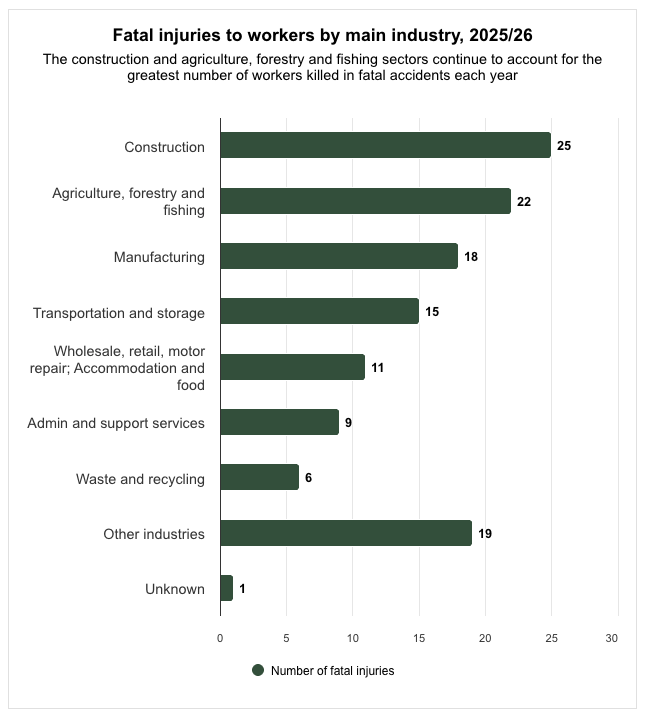
Many of these incidents share common contributing factors:
• Inadequate risk assessments.
• Poor supervision or communication.
• Lack of training or competence.
• Failure to learn from near misses.
• Inconsistent safety procedures across sites or contractors.
What can organisations do differently to improve workplace safety?
Preventing fatal injuries isn’t about one big intervention — it’s about building a system that consistently identifies hazards, controls risks, monitors compliance and learns from every incident and near miss.
That’s where an integrated SHEQ platform becomes valuable.
How m2i.SHEQ supports fatality prevention
A solution like m2i.SHEQ software provides the digital infrastructure to manage safety proactively — not just reactively. And it scales from small to enterprise level. Here’s how it helps address the factors behind serious incidents:
| Risk Factor | How m2i.SHEQ Helps |
| Inadequate risk assessments | Centralised risk registers with review schedules, ensuring assessments are current and accessible |
| Inconsistent procedures | Document control with version management, approvals, and acknowledgement tracking |
| Gaps in training | Competency management with certification tracking, expiry reminders, and training records |
| Unreported near misses | Simple incident reporting (including mobile) to capture near misses before they escalate |
| Poor follow-through on actions | Action tracking with ownership, deadlines, escalation, and effectiveness reviews |
| Limited visibility of trends | Dashboards and analytics that highlight patterns across sites, contractors, and incident types |
| Audit and inspection gaps | Scheduled audits and inspections with findings, evidence capture, and corrective actions |
| Siloed safety information | A single platform for safety, health, environment, and quality — breaking down data silos |
From reactive to proactive
Too often, serious injuries prompt a reactive response: investigate, implement corrective actions, move on. But the organisations with the strongest safety records are those that act before incidents occur.
This means:
• Treating near misses as valuable leading indicators.
• Reviewing risk assessments regularly — not just when something goes wrong.
• Ensuring actions from audits and inspections are closed out effectively.
• Using data to identify emerging risks before they result in harm.
A SHEQ platform makes this proactive approach sustainable by reducing administrative burden, standardising processes, and keeping safety visible at every level of the organisation.
The bottom line
The 2025/26 RIDDOR figures remind us that while progress has been made, workplace fatalities remain a reality — and the pace of improvement is slowing.
For organisations serious about protecting their people, the question isn’t whether you have a safety policy. It’s whether you have the systems in place to ensure that policy is followed consistently, risks are identified early, and lessons are learned from every incident.
That’s the role a SHEQ platform like m2i.SHEQ plays — providing the digital backbone for a safety management system that doesn’t just respond to incidents, but works to prevent them.
Want to see how m2i.SHEQ could strengthen your safety management? Request a demo or get in touch to discuss your requirements.